
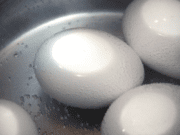
Remember when eggs were easy to peel? Even FUN!?
Now they are a pain to peel. But we can fix that. Read on…
Factors That Affect Peelability
Several things influence how easy an egg is to peel:
Egg Freshness
Fresh eggs are typically the hardest to peel.
As eggs age, they slowly lose moisture through tiny pores in the shell. This causes the contents of the egg to shrink slightly and increases the size of the air pocket inside the shell.
Those changes help separate the membrane from the egg white, making older eggs easier to peel.
Egg Size
Larger eggs can sometimes be more difficult to peel than smaller eggs because cooking times become more critical.
Chicken Breed and Age
Some evidence suggests that eggs from different breeds and ages of hens may peel differently, although consumers generally have little control over this when shopping.
Storage Conditions
Refrigerated eggs generally produce more consistent results than eggs stored at room temperature.
Choosing Eggs That Peel More Easily
If possible, avoid using eggs that were laid just a day or two ago.
Store-bought eggs are usually old enough that this isn’t a problem, but if you keep backyard chickens, allowing eggs to age in the refrigerator for a week or two before boiling can make a noticeable difference.
According to the USDA, eggs can typically be stored safely in the refrigerator for three to five weeks after purchase. The older they are in that range, the easier they are to peel. Get your eggs for your favorite deviled eggs recipe a few weeks before you make them.
Cooking Easier to Peel Hard-Boiled Eggs
After years of experimenting, I’ve found a method that produces eggs that peel far more easily than the traditional “start in cold water” approach.
Step 1: Bring the Water to a Boil First
Fill a saucepan with enough water to fully cover the eggs and bring the water to a gentle boil.
Step 2: Carefully Lower in the Eggs
Using a spoon or slotted spoon, carefully lower the eggs into the boiling water.
Don’t drop them in. A sudden impact can crack the shells.
Adding the eggs directly to already-boiling water appears to help the egg white set more quickly, reducing its tendency to bond tightly to the membrane.
Step 3: Boil for 13–14 Minutes
Maintain a gentle boil and cook the eggs for 13 to 14 minutes.
For large eggs, this usually produces a fully cooked yolk without leaving the center underdone.
Step 4: Move Immediately to Ice Water
As soon as the cooking time is complete, transfer the eggs to a bowl of ice water.
Allow them to cool for at least 10 to 15 minutes.
The rapid cooling helps the egg contract slightly, creating separation between the egg and the membrane.
How to Peel Hard-Boiled Eggs
Once the eggs are cooled:
Gently tap the egg on a hard surface in several places.
Roll it lightly to create multiple cracks.
Start peeling from the wider end, where the air pocket is located.
Try to remove the shell and membrane together.
If you encounter stubborn spots, peeling the egg under running water can help loosen small shell fragments.
Do Baking Soda or Vinegar Help?
You’ll often see recommendations to add baking soda or vinegar to the cooking water.
Some people report good results, while others notice little difference. If you’re still struggling with peeling, they’re inexpensive tricks worth trying, but changing the cooking method usually has a much bigger impact.
Final Thoughts
If hard-boiled eggs seem harder to peel than they used to be, there may be some truth to that observation. Freshness, storage conditions, and even the eggs themselves can affect the results.
But the single biggest improvement I’ve found is surprisingly simple: start with boiling water, carefully lower the eggs in, cook them for 13 to 14 minutes, and then immediately transfer them to an ice bath.
That one change has consistently produced cleaner, easier-to-peel eggs and a lot less frustration in the kitchen.


